

~ IndiaTech.org and Consumer VOICE study of 15 states finds buyers and sellers of used vehicles pay
close to 10 times the official transfer fee. Uttar Pradesh, Bihar and West Bengal rank last. ~
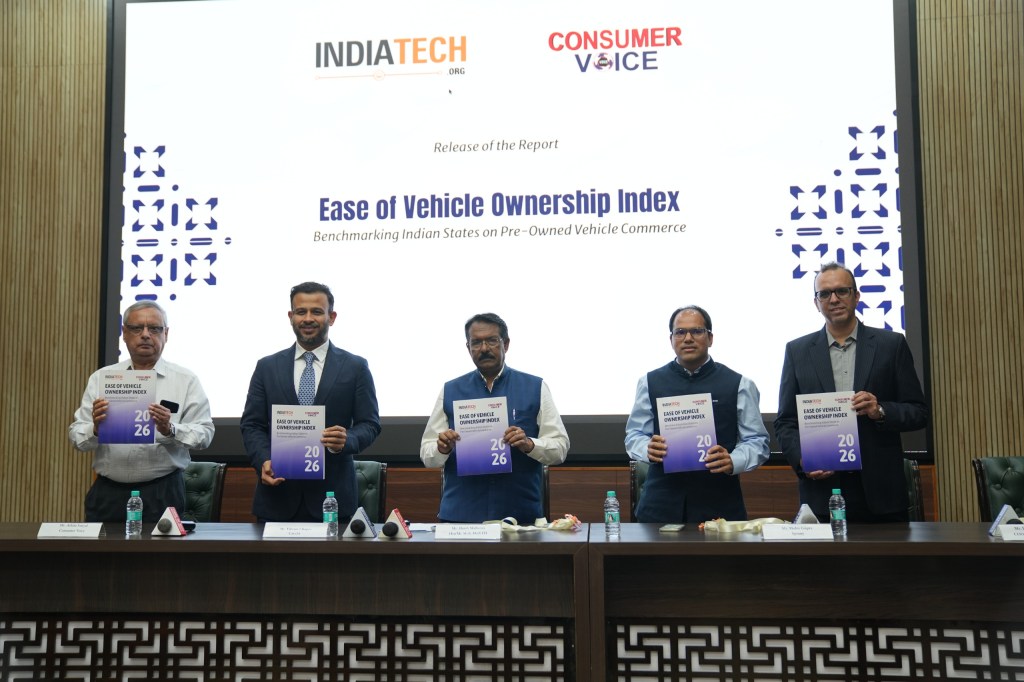
New Delhi, 04 November 2026: Andhra Pradesh has topped the first Ease of Vehicle Ownership Index (EVOI), released today by IndiaTech.org in partnership with Consumer VOICE. The index ranks 15 states and Union Territories on how easily a citizen or dealer can buy, sell and transfer a pre-owned vehicle. Andhra Pradesh scored 5.91 out of 10 and Kerala 5.74. Uttar Pradesh came last at 2.47, just behind Bihar (2.51) and West Bengal (2.56).
No state crossed 6.0. Eight of the 15 sit in a narrow band between 3.8 and 4.3, which points to friction across the system rather than in a few laggard states. Together, the 15 states account for over 85% of India’s organised used-car market.
The EVOI scores each state on six pillars: policy and regulatory framework, digital infrastructure, process efficiency, transparency and accountability, institutional ecosystem and dealer support, and cost and affordability. Pillar scores are combined using a weighted geometric mean, so strength in one area cannot mask weakness in another. The findings draw on a pan-India survey of over 1,000 buyers and sellers, interviews with dealers, RTO agents and sector experts, and a review of central and state motor vehicle rules.
Launching the report, Hon’ble Minister of State, Ministry of Road Transport and Highways, Shri. Harsh Malhotra, said, “The used car market in India is very big, and many people buy their first car as a second-hand or used car. I remember my first car, which was also a pre-owned car. While there are hassles and challenges in the transfer of ownership, the integration of policies and their implementation across states is very important, as differences in state-level governance often lead to problems. The Central Government is working on policies in this regard, and we are also taking steps such as setting up automated testing stations, which provide considerable relief, promote ease of doing business and help eliminate corruption. There is always scope for improvement, and we will discuss the recommendations basis this report findings to further enable ease of mobility.”
EVOI 2026: state rankings
| Rank | State | Score (out of 10) | Strongest pillar | Weakest pillar |
| 1 | Andhra Pradesh | 5.91 | Policy and regulation (7.90) | Dealer ecosystem (2.22) |
| 2 | Kerala | 5.74 | Digital infrastructure (7.02) | Transparency (4.86) |
| 3 | Tamil Nadu | 4.58 | Digital infrastructure (5.43) | Cost (3.13) |
| 4 | Delhi | 4.58 | Digital infrastructure (6.81) | Cost (3.31) |
| 5 | Karnataka | 4.30 | Policy and regulation (5.14) | Cost (3.75) |
| 6 | Gujarat | 4.16 | Transparency (6.03) | Cost (1.81) |
| 7 | Madhya Pradesh | 4.10 | Digital infrastructure (6.23) | Cost (2.19) |
| 8 | Maharashtra | 4.09 | Digital infrastructure (5.21) | Cost (1.94) |
| 9 | Telangana | 4.09 | Process efficiency (5.84) | Cost (2.50) |
| 10 | Punjab | 4.03 | Digital infrastructure (6.35) | Cost (1.94) |
| 11 | Rajasthan | 3.97 | Dealer ecosystem (7.32) | Transparency (2.52) |
| 12 | Haryana | 3.86 | Transparency (4.98) | Cost (1.94) |
| 13 | West Bengal | 2.56 | Transparency (5.80) | Cost (1.00) |
| 14 | Bihar | 2.51 | Transparency (4.70) | Cost (1.13) |
| 15 | Uttar Pradesh | 2.47 | Digital infrastructure (3.94) | Cost (0.56) |
Findings of the Index:
Cost is the weakest pillar nationally, with 12 of 15 states scoring below 3.5. Manual verification and informal payments push the real cost of a transfer to nearly 10 times the statutory fee. In Bihar, a single transfer can cost ₹13,000 to ₹14,000 over and above the fee prescribed on VAHAN. At border RTOs in Tamil Nadu such as Hosur and Krishnagiri, an official fee of about ₹800 becomes ₹7,000 to ₹8,000.
Typical RC transfer times run from 7 to 10 days in Andhra Pradesh, where buyer, seller and lender authenticate biometrically, to more than 30 days in Uttar Pradesh. In 13 of the 15 states, applicants file online and are still asked to deliver physical copies to the RTO.
Road tax on a ₹6 lakh petrol car ranges from 3% in Uttar Pradesh to 14% in Karnataka and Telangana, a difference of over ₹66,000 on the same vehicle. Only Andhra Pradesh and Telangana run a working refund for vehicles that leave the state. A March 2026 CAG audit of 145 motor vehicle tax refunds in Karnataka found a mean processing time of 436 days.
The Deemed Ownership framework, notified in 2022 under GSR 901(E), lets authorised dealers take legal responsibility for vehicles in their stock. Four years on, India has 2,032 such registered dealers, 875 of them in Kerala. Delhi, Karnataka and Telangana have none; Andhra Pradesh, Haryana, Punjab and Uttar Pradesh have three or fewer each.
The citizen survey of over 1,000 buyers and sellers found that:
- 39% said their RC transfer was still pending after the sale, and only 9.6% saw it completed within two weeks
- 61.5% did not know an in-person appearance at the RTO (party peshi) was required until they got there
- 62.7% could not say what the transfer had cost them in total
- 28.1% of sellers received challans or legal notices after handing over the vehicle
- 52.5% would complete the transfer themselves if the process were fully online and clearly documented
On the report, Mr. Dhiraj Gyani, CEO of IndiaTech.org, said, “A vehicle may travel seamlessly across state boundaries, but the administrative processes governing its ownership often do not. As India’s pre-owned vehicle market becomes an increasingly important part of our mobility and consumer economy, the systems governing ownership transfers must evolve in step with the market. The EVOI 2026 findings highlight significant variations in state-level processes, as well as considerable scope for improvement across the country. Our objective is to encourage greater harmonisation, digital integration and administrative efficiency, enabling citizens and businesses to experience seamless and predictable vehicle ownership transfers, irrespective of where they are located. We believe that a more integrated national framework, including progress towards the vision of ‘One Bharat, One Road Tax’, can play an important role in unlocking the sector’s full potential.”
The stakes are rising with the market. India’s pre-owned vehicle market is projected to grow from USD 36.4 billion in 2025 to USD 73.5 billion by 2030, when used cars are expected to outsell new ones 1.7 to 1. Between 60% and 65% of buyers in the organized segment are first-time car owners.
Mr. Mohit Gupta, COO & Co-founder, Spinny, present at the launch, said, “Every Indian deserves the opportunity to own a quality car. A car is an aspiration, the promise of new beginnings, freedom and possibilities for individuals and families. Buying one should be an exciting milestone, not weighed down by paperwork and complex processes.
As an industry, we have a responsibility to help consumers understand existing processes and work closely with policymakers to drive meaningful reforms — support state-wise implementation of ADRV, simplify hypothecation addition and removal, and advance end-to-end digitisation of processes.
The Ease of Vehicle Ownership Index (EVOI) is an important step towards bringing Central and State Governments and industry players together to address these challenges and make car ownership simpler and easier for people across India.”
Mr. Vikram Chopra, Builder Cars24, said, “A car may change hands, but ownership and liability do not always follow. At Cars24, we see this firsthand: sellers remain exposed to liabilities long after handing over their vehicles, while buyers wait to be recognised as legal owners despite completing the purchase. This is not just a procedural delay, but a gap in consumer protection and accountability. The Ease of Vehicle Ownership Index brings these challenges to light, identifies systemic gaps and gives states a framework to drive reforms through competitive federalism. Ownership transfer must be an integral part of every car transaction, ensuring that ownership, responsibility and liability move together, giving both buyers and sellers complete peace of mind.”
Report Recommendations
The report sets out a reform roadmap that states can largely act on within their existing powers. Its main proposals are:
- Statutory timelines for transfers through amendments to Section 50 of the Motor Vehicles Act, 1988 and Rule 55 of the CMVR: approval within 24 to 48 hours, RC dispatch within 2 to 3 days, interstate NOCs within 48 hours and road tax refunds within 14 days
- DigiLocker and mParivahan documents accepted as primary evidence at every RTO, ending dual online and physical submission
- Real-time integration between banks and VAHAN so hypothecation is removed automatically when a loan closes
- Deemed Ownership enforced in every state, backed by a national registry of authorised dealers and a simpler route for dealers with turnover below ₹20 lakh
- A “One Bharat, One Road Tax” framework and a standard digital refund module on Parivahan
- Authorised dealers allowed to clear pending challans during a transfer without the owner’s OTP
- Own-damage insurance cover carried over automatically on transfer, as third-party cover already is
IndiaTech.org will engage with the transport departments of the 15 states and Union Territories, sharing individual scorecards and recommendations to support state-level reforms. The association will also convene a national workshop to bring together policymakers and industry stakeholders to deliberate on priority reforms for a more seamless vehicle ownership ecosystem
The full report and state scorecards are available at https://indiatech.org/whitepapers/
Ends
About IndiaTech.org
IndiaTech.org (registered as Technology Services Industry Association) is an industry association established by founders of leading Indian startups, unicorns, and investors, working with policymakers to strengthen India’s digital economy and advance technology and innovation-led growth.
About Consumer VOICE
Established in 1983, it is one of India’s pioneering consumer organisations, working to empower and protect consumers through consumer education, independent product testing, research, and policy engagement, while collaborating closely with governments, regulators, and the judiciary.

