

Special Correspondent: Arun Sharma
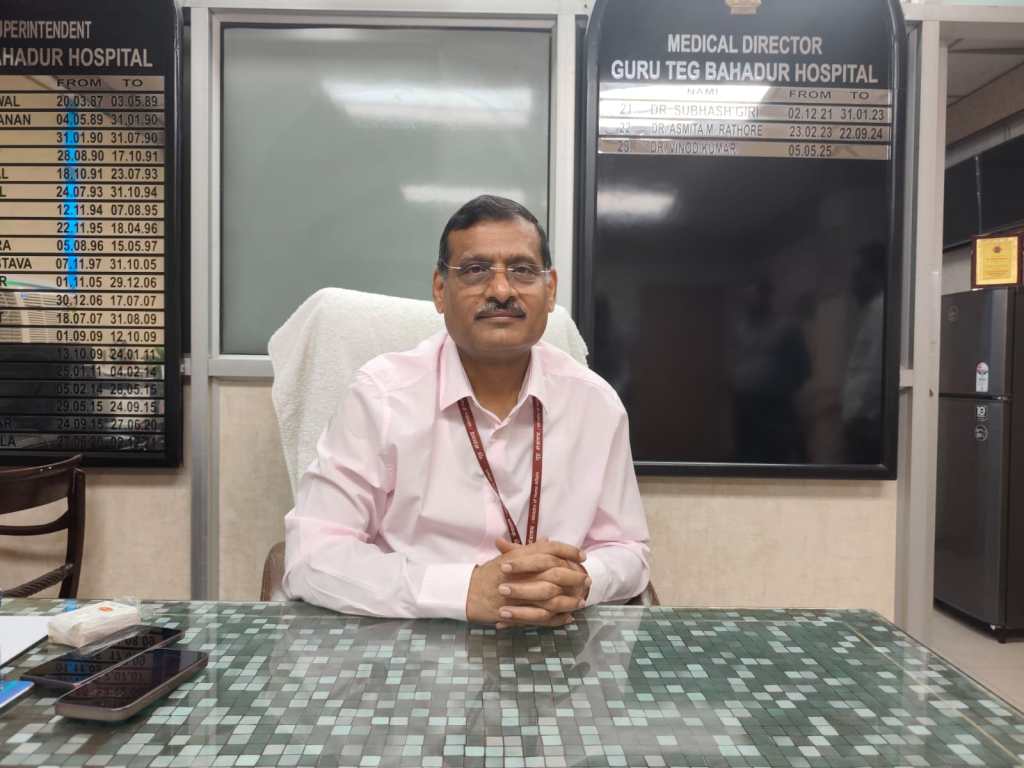
East Delhi (Dilshad Garden): At Guru Teg Bahadur Hospital, one of the capital’s prominent public healthcare institutions, a quiet but significant transformation is underway. In an exclusive administrative-level interaction, Medical Director Dr. Vinod Kumar outlined how the Delhi Government’s ambitious “Mega Hospital Integration Plan 2030” is set to redefine patient care, infrastructure, and service delivery across the capital.
Patient-Centric Reform at the Core
Dr. Vinod Kumar emphasized that the initiative is far more than a structural overhaul—it is a patient-first governance model.
“The integration of hospitals will eliminate unnecessary patient movement. A coordinated system will ensure faster, more efficient, and seamless treatment delivery,” he stated.
According to him, the reform is designed to reduce fragmentation in healthcare services and establish a streamlined referral and treatment ecosystem.
Strong Endorsement of Delhi Government’s Vision
Praising the Delhi Government’s proactive approach, Dr. Kumar highlighted that the scale of investment, infrastructure expansion, and policy innovation reflects a clear administrative commitment to strengthening public healthcare.
He noted that:
Modernization of hospital infrastructure is being prioritized
Advanced medical equipment and technologies are being rapidly deployed
Recruitment and expansion of medical and paramedical staff are ongoing
“The government’s vision is clear—timely, accessible, and quality healthcare for every citizen,” Dr. Kumar affirmed.
GTB Hospital Emerging as a Super-Speciality Hub
Under the integration blueprint, Guru Teg Bahadur Hospital is being strategically positioned as a major super-speciality hub for East Delhi.
This development is expected to:
Enhance access to advanced treatment for millions in surrounding areas
Enable local availability of specialized care for critical illnesses
Reduce patient load on other tertiary hospitals
Addressing Overcrowding and Resource Gaps
Acknowledging existing challenges, Dr. Kumar admitted that high patient inflow remains a concern. However, he expressed confidence that the integration model will:
Ensure better patient distribution across facilities
Strengthen referral mechanisms
Optimize utilization of beds, staff, and medical resources
A Digitally Integrated Healthcare Future by 2030
Looking ahead, Dr. Vinod Kumar projected that by 2030, Delhi’s healthcare system will evolve into a fully digital, integrated, and patient-centric network.
“Once implemented, this model can position Delhi as a benchmark for public healthcare delivery in India,” he added.
Conclusion
As articulated by Dr. Vinod Kumar, Guru Teg Bahadur Hospital is not just a healthcare facility but a central pillar in Delhi Government’s reform-driven health policy. His insights underline a governance framework where administrative clarity, infrastructural investment, and patient welfare converge—offering a promising roadmap for the future of public healthcare in the national capital.

