

Special Correspondent Arun Sharma
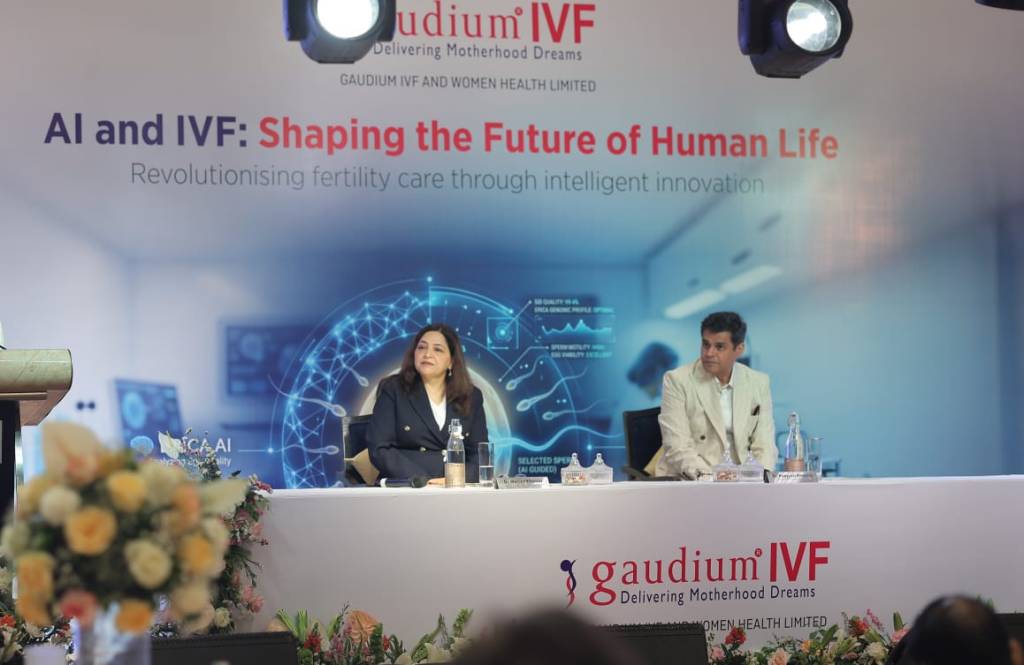
New Delhi: In a significant leap for India’s fertility care sector, Gaudium IVF has introduced artificial intelligence (AI)-driven infertility treatment, marking a transformative moment in reproductive medicine. The development comes just weeks after the organisation became the country’s first publicly listed IVF chain, reinforcing its position at the forefront of innovation.
The initiative was formally unveiled by Union Minister for Road Transport and Highways, Nitin Gadkari, who highlighted the growing role of technological innovation in shaping India’s healthcare ecosystem. His presence underscored the increasing convergence of public policy and advanced medical solutions.
At the heart of this advancement is the integration of AI into routine embryology practices—an area traditionally dependent on manual expertise. With the introduction of systems such as SiD (Sperm Identification Device) and ERICA, Gaudium IVF is enabling a shift toward data-driven precision in critical stages of IVF treatment.
SiD leverages AI algorithms to analyse sperm movement and behaviour, allowing embryologists to select the most viable sperm for fertilisation. Complementing this is ERICA, an AI-powered tool that evaluates embryo images and ranks them based on developmental potential, thereby assisting in identifying embryos with the highest chances of success.
This technological leap has been achieved in collaboration with a UK-based innovation group specialising in embryology intelligence. The partnership effectively bridges global expertise with India’s rapidly evolving clinical landscape, making cutting-edge solutions more accessible to patients.
According to the Chairperson and Managing Director of Gaudium IVF, the integration of AI marks the beginning of a new phase in fertility care—one where outcomes are increasingly guided by predictive insights and precision analytics. She noted that such advancements not only improve success rates but also enhance transparency and patient trust throughout the treatment journey.
Experts believe that the use of non-invasive AI tools can significantly reduce variability in clinical decision-making, leading to improved fertilisation outcomes and stronger embryo development. In the long term, this may also reduce the need for repeated IVF cycles, easing both the emotional and financial burden on patients.
As India moves towards what many are calling “IVF 2.0,” Gaudium IVF’s latest initiative reflects a broader transformation within the healthcare sector—where technology is not just an enabler, but a driving force behind better, more reliable, and patient-centric care
 Modern Shrines Publications