

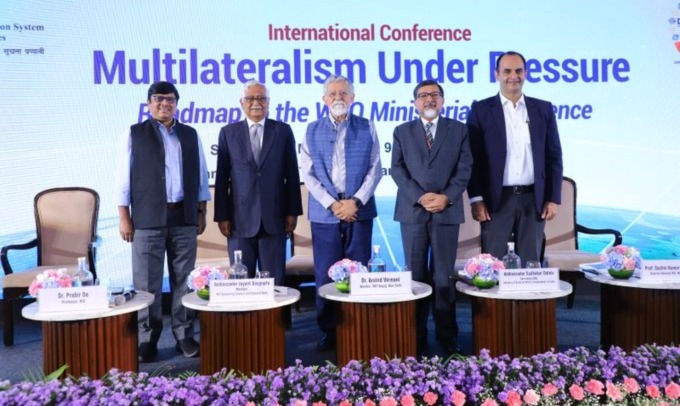
The Research and Information System for Developing Countries (RIS) convened an international conference on “Multilateralism Under Pressure” and launched its flagship World Trade and Development Report (WTDR) 2026, bringing together policymakers, diplomats, economists, and scholars ahead of the 14th WTO Ministerial Conference.Held at a critical juncture for the global economy, the conference examined the deepening challenges confronting the multilateral trading system, including rising geopolitical tensions, fragmentation of supply chains, and increasing recourse to unilateral and industrial policy measures. Discussions collectively underscored that the forthcoming Ministerial Conference will be pivotal in restoring credibility, trust, and balance within the global trading architecture.
Welcoming the participants, Sachin Kumar Sharma, Director General of RIS, highlighted that multilateralism is under strain from both external and internal pressures. He pointed to geopolitical fragmentation, intensifying industrial policy competition, and disruptions in global supply chains, alongside persistent institutional challenges such as stalled negotiations and a non-functional dispute settlement system. He emphasised that MC14 presents a crucial opportunity to re-anchor the development dimension of global trade, preserve policy space for developing countries, and reinvigorate multilateral cooperation. He also reaffirmed RIS’s commitment to supporting policymaking through rigorous, evidence-based research and dialogue, noting its active engagement in ongoing WTO processes.
Setting the analytical tone for the conference, Arvind Virmani, Member of NITI Aayog, outlined a forward-looking framework for India’s trade strategy within a shifting global economic landscape. He identified two structural trends, the increasing concentration of manufacturing in a limited number of economies and changing demographic dynamics, and argued that India is well-positioned to emerge as a global supplier of human capital. He stressed that India’s trade policy must align with its long-term vision of Viksit Bharat, anchored in competitiveness, quality, and scale. In this context, he highlighted the importance of deepening engagement through free trade agreements (FTAs) with developed economies to facilitate integration into global value chains and attract investment, while underscoring the role of industrial policy as a transitional instrument for building long-term competitiveness.
Situating these issues within the broader global context, Sudhakar Dalela, Secretary (ER) at the Ministry of External Affairs, emphasised that the multilateral trading system is increasingly shaped by geopolitical tensions, technological transformations, and the reconfiguration of supply chains. Moreover, he also highlighted the growing trust deficit within the World Trade Organization, he called for credible, inclusive, and development-oriented reforms, stressing that rebuilding trust must be at the core of outcomes at MC14.
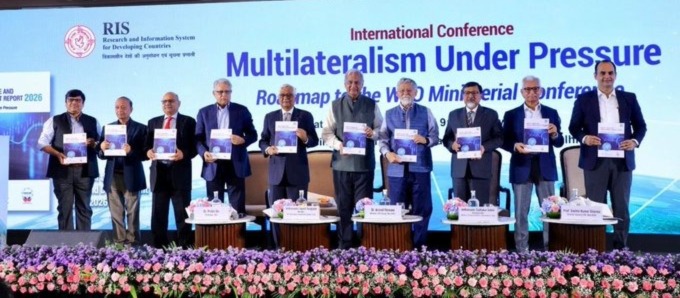
Echoing these concerns, Senthil Pandian C., Ambassador of India to the World Trade Organization, reaffirmed the continued relevance of a rules-based multilateral system while cautioning against the erosion of its foundational principles. He drew attention to challenges facing core WTO norms, including Most-Favoured-Nation (MFN) treatment, consensus-based decision-making, and development-oriented provisions. Emphasising the urgency of restoring trust, he called for revitalising Special and Differential Treatment (S&DT), re-establishing a fully functional dispute settlement mechanism, and ensuring that reform processes remain inclusive, transparent, and member-driven, particularly in safeguarding the interests of developing countries.The launch of the World Trade and Development Report 2026 marked a key highlight of the conference. Prepared through extensive consultations involving over 39 experts, the report provides a comprehensive and development-focused analysis of key issues shaping the global trade landscape, including WTO reform, dispute settlement, Special and Differential Treatment, trade and sustainability, agriculture, fisheries subsidies, digital trade, and industrial policy. Bringing together diverse perspectives and rigorous analysis, the report aims to contribute meaningfully to ongoing global trade debates and to support the Global South in shaping a more inclusive, balanced, and development-oriented multilateral trading system. At a time of deepening fragmentation, the daylong conference concluded with a clear message- the future of the global trading system will depend on the ability of the World Trade Organization to adapt, rebuild trust, and deliver outcomes that are credible, inclusive, and development-oriented.
 Modern Shrines Publications