

New Delhi | Special Correspondent: Arun Sharma
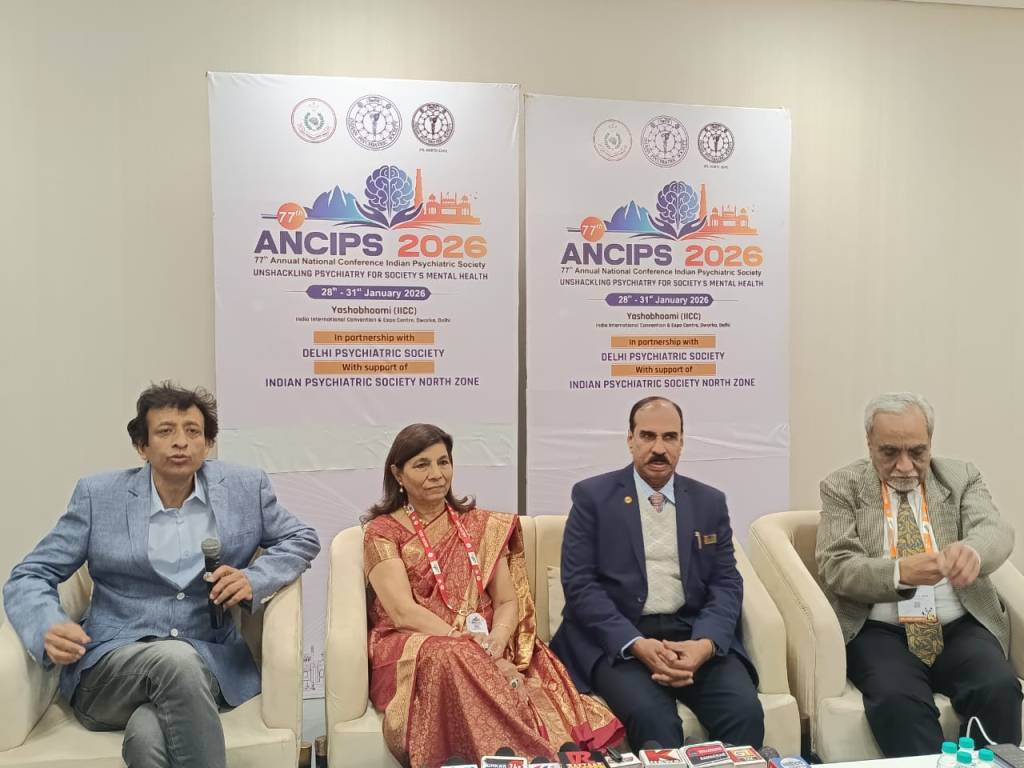
A stark warning for India and the world emerged from the 77th Annual National Conference of the Indian Psychiatric Society (ANCIPS 2026), where leading mental health experts revealed that nearly 60 per cent of mental disorders are diagnosed in individuals below the age of 35. The findings underscore a global mental health crisis unfolding far earlier in life than previously understood.
The four-day conference, being held from January 28 to 31 at Yashobhoomi, New Delhi, has brought together psychiatrists, clinicians, researchers and policymakers from across India and abroad to deliberate on the rising burden of mental illness among adolescents and young adults.
Experts noted that mental disorders often begin during adolescence or early adulthood, with the median age of onset between 19 and 20 years. Studies presented at the conference, including large-scale international research published in Molecular Psychiatry, indicate that 34.6% of mental disorders begin before age 14, 48.4% before 18, and 62.5% by the age of 25—a pattern seen across countries and cultures.
By early adulthood, most cases of ADHD, anxiety disorders and eating disorders have already emerged, while depression, substance use disorders and behavioural addictions are increasingly being reported at much younger ages. Experts warned that when left untreated, early-onset mental disorders often become chronic, leading to lifelong disability and significant social and economic costs.
Dr. Deepak Raheja, Organising Secretary, ANCIPS Delhi, stated:
“When 60 per cent of mental disorders affect people below 35, it signals a crisis that strikes during the most productive years of life. These are the years of education, career-building and nation-building. Early identification, school- and college-based interventions, and destigmatisation are no longer optional—they are essential.”
Suicide trends discussed at the conference further highlighted the urgency of the situation. According to the World Health Organization (WHO), suicide is now the third leading cause of death among individuals aged 15 to 29 globally, transforming youth mental health into a public health emergency rather than merely a clinical issue.
Recent data also reveal a sharp rise in psychological distress among young adults, with studies showing a 101.7% increase in frequent mental distress among individuals aged 18–25 between 2011 and 2021. Experts linked this surge to academic pressure, unemployment, social isolation, excessive digital exposure, substance use and unresolved emotional stress—trends mirrored in many countries worldwide.
Dr. Nimesh G. Desai, Chairperson, ANCIPS 2026 Organising Committee, observed:
“Excessive dependence on the digital and virtual world will further amplify mental health problems in the coming years. The biggest challenge in India—and globally—is delayed treatment. If addressed early, most mental disorders are treatable, allowing individuals to lead normal, productive lives.”
Dr. Savita Malhotra, President, Indian Psychiatric Society, said:
“Rapid social change has transformed the lived experiences of young people. Intense academic competition, constant digital comparison, loneliness despite connectivity, and uncertainty about employment and relationships are reshaping mental health risks. Services must evolve to become youth-friendly, accessible and stigma-free.”
Dr. T.S.S. Rao, President-Elect, Indian Psychiatric Society, added:
“No country can reap its demographic dividend if its youth are silently suffering. Mental health must be integrated into primary healthcare, education systems, workplaces and communities. Investing in mental health is not a cost—it is an investment in the future of nations.”
ANCIPS 2026 has emerged as a crucial global platform to address the vast mental health treatment gap, with estimates suggesting that 70–80 per cent of people with mental disorders still do not receive timely or adequate care. Through scientific sessions, policy dialogues and community-focused discussions, the conference aims to push for stronger mental health policies, increased funding, workforce expansion and nationwide awareness—particularly for children, adolescents and young adults.
The message resonating from New Delhi is clear and universal: mental disorders are beginning earlier, spreading faster, and affecting societies worldwide. Experts warned that ignoring this crisis would come at a cost no nation can afford.
 Modern Shrines Publications