

India–UAE Strategic Defence Pact Signals New Direction in Foreign Policy
New Delhi | Special Correspondent: Arun Sharma
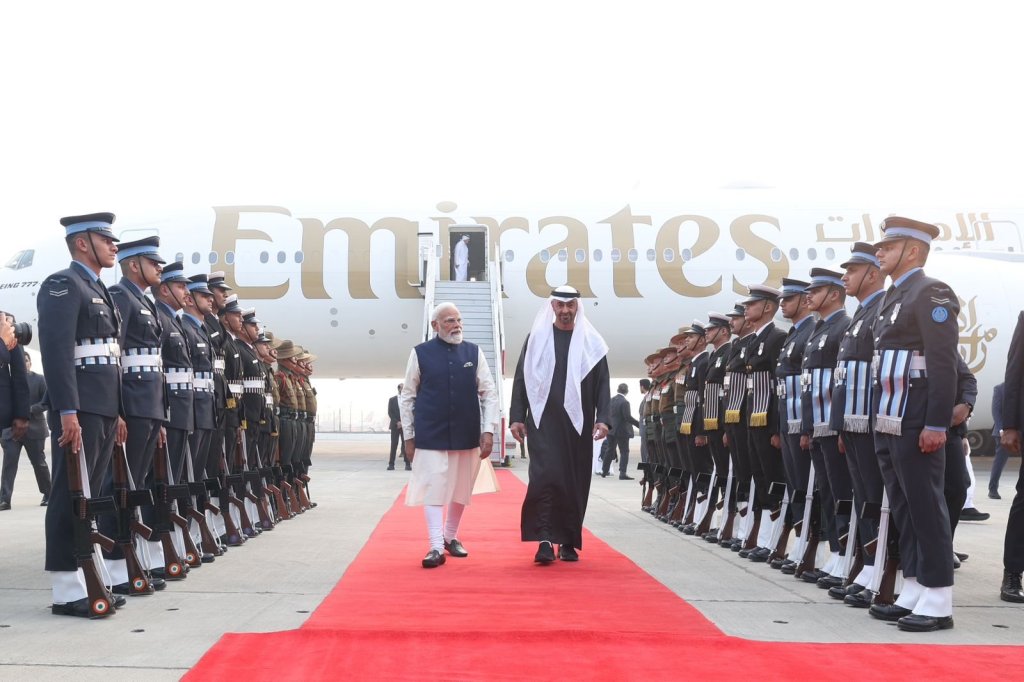
Under the assertive and forward-looking foreign policy of Prime Minister Narendra Modi, India is steadily reinforcing its position as a decisive player in global geopolitics. The latest elevation of India–United Arab Emirates (UAE) ties into a strategic defence partnership marks not just a bilateral milestone, but a significant international development with far-reaching regional and global implications.
During the visit of UAE President Sheikh Mohamed bin Zayed Al Nahyan to New Delhi, Prime Minister Modi led high-level talks that resulted in a Letter of Intent to deepen defence and security cooperation. The move reflects India’s evolving diplomatic doctrine—focused on strategic autonomy, diversified partnerships and active engagement with key powers across regions.
At the heart of the discussions was a shared vision to expand defence collaboration across sectors such as defence manufacturing, advanced technology, cyber security, counter-terrorism, military training and joint exercises. Officials described the agreement as a natural progression of the already robust India–UAE Comprehensive Strategic Partnership, now firmly anchored in security and defence cooperation.
Equally significant was the announcement of an ambitious economic roadmap. Both countries agreed to work towards doubling bilateral trade to $200 billion by 2032, positioning the India–UAE economic corridor as a vital link between South Asia, the Middle East and global markets. Analysts view this as a strategic response to shifting global supply chains and growing economic uncertainties worldwide.
Prime Minister Modi’s personal diplomacy was also on full display, as he welcomed the UAE President and his wife with traditional Indian warmth and symbolic cultural gifts. The gesture underscored the emphasis India places on people-to-people ties and cultural diplomacy as integral components of its foreign policy outreach.
On global security issues, both leaders delivered a strong and unambiguous message against terrorism. Reaffirming their “zero tolerance” approach, they stressed that no nation should provide safe haven, funding or logistical support to terrorist networks—an assertion that resonates strongly amid rising international concerns over cross-border terrorism and regional instability.
The talks further covered regional developments in West Asia, energy security, climate cooperation, space collaboration and emerging technologies. India’s support for enhanced connectivity initiatives and its growing engagement with the Middle East were seen as part of a broader strategy to balance relations across major global power centres.
Foreign policy experts note that under Prime Minister Modi, India has transitioned from a reactive diplomatic posture to a confident, agenda-setting global role. The strengthening of ties with the UAE—one of the most influential nations in the Gulf—reinforces India’s image as a reliable strategic partner and a stabilising force in an increasingly multipolar world.
With defence, trade and diplomacy converging, the India–UAE partnership now stands as a prominent example of New Delhi’s international outreach, reflecting Prime Minister Modi’s vision of a globally engaged, strategically autonomous and economically resilient India—a narrative that firmly places this development on the national page with unmistakable international resonance.
 Modern Shrines Publications