

Communal Violence in India 2025:Declining Figures, Deepening Social Divides and a New Challenge to Democracy

The changing nature of violence, becoming more decentralized,unplanned, individual, or mob-based, reflects the continued presence of deep mistrust and hatred within society-Advocate Kishan Sanmukhdas Bhawnani
Gondia – The statement made by the Indian Prime Minister from the stage of the Pongal festival held in Delhi on January 14, 2026, that farmers have a significant contribution to nation-building, was not merely a cultural or ceremonial statement, but a political- ideological message pointing towards the soul, economy, and social fabric of India. Pongal, a festival celebrating agriculture, nature, and labor, symbolizes the very essence of India, whose roots are deeply embedded in its fields.

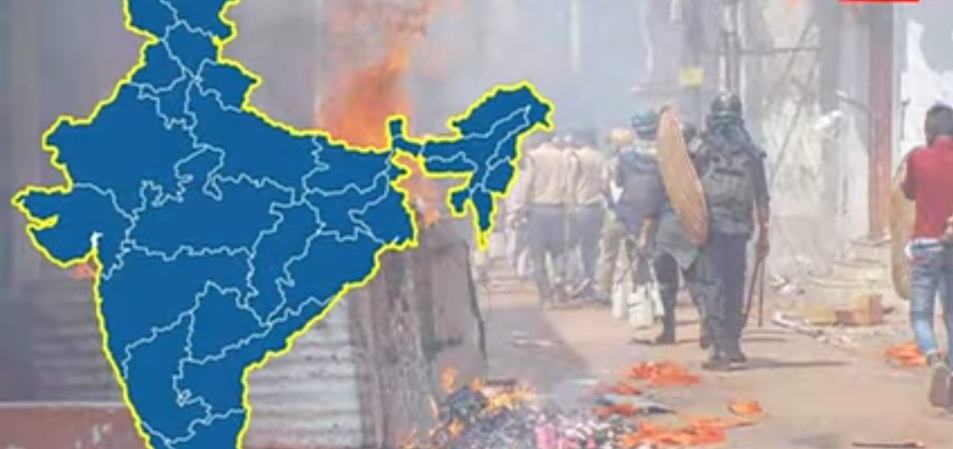
However, a recent monitoring report published by the Center for Study of Society and Secularism (CSSS) during the same period presents a picture of an India where, despite a decline in communal riots,mob lynching, hate crimes, and identity-based violence continue to pose a serious challenge to democracy.
I, Advocate Kishan Sanmukhdas Bhawnani, Gondia, Maharashtra, believe that India is the world’s largest democracy, whose social structure is built on a multi-religious, multilingual, and multicultural fabric. In such a society, communal harmony is not merely a question of internal stability, but also a moral and political indicator for the global democratic world.Therefore, this article presents an international analysis of India’s contemporary socio-political landscape between these two parallel realities, hope and concern. This article is based on the CSSS report; its accuracy cannot be independently verified.
Friends, if we talk about understanding agriculture and nation-building: the cornerstone of Indian civilization, then in India, agriculture is not just an economic activity, but a civilizational structure. From the Indus Valley Civilization to modern India, farmers have been the cornerstone of societal stability, food security, and cultural continuity.The Prime Minister’s statement from the Pongal platform reiterates this historical truth. In a global context, at a time when even developed countries consider food self-sufficiency a part of national security,India’s farmer-centric discourse presents it as a sustainable development model.International institutions like the FAO and the World Bank also acknowledge that India’s agricultural system, despite all its challenges, remains a stable pillar during times of global food crisis. Pongal is not merely a festival of Tamil culture, but a symbol of the collective celebration of labor,nature,and community. When a person holding a constitutional office like the Prime Minister describes farmers as heroes of nation-building through this festival,the message is not only domestic but also global.It presents India as a country where the development model is rooted in the grassroots. However, this inclusive cultural message isweakened when identity-based violence and the politics of hatred within society damage the social fabric. According to the CSSS 2025 monitoring report,there has been a significant decline in the number of major communal riots recorded in India.This is a positive sign and can be attributed to improvements in law and order,swift administrative intervention,and judicial activism. Internationally,this is a reassuring figure for India, as global human rights organizations have long raised concerns about communal violence in the country. However, the other side of the report is more worrying: the violence has not ended, but has taken on new, more decentralized, and unpredictable forms.
Mob Lynching: The Rise of the Mob and the Test of the State Mob lynching is considered one of the most horrific failures of moderndemocracy. In India, this violence is often fueled by rumors, identity, and social prejudices. The CSSS report indicates that in 2025…While incidents of mob lynching may not have received the same level of media attention as large-scale riots, their social damage has been far more profound.In international human rights discourse, mob lynching is viewed as an unofficial justice system, where the legitimacy of the state and the rule of law are directly challenged.
Hate Crimes: A Global Trend, the Indian Context: Hate crimes are not solely an Indian problem They are an emerging global trend in the US, Europe, and many parts of Asia. However, their complexity in India is heightened because identity based on religion, caste, language, and region—is deeply intertwined with history.According to the CSSS report, a significant portion of hate crimes in 2025 was linked to misinformation stemming from social media and political polarization.This situation is a serious warning for India’s digital democracy. Identity-Based Violence and Social Fragmentation: The greatest threat of identity-based violence is that it permanently divides society.Farmers, laborers, and low-income groups, who contribute most to nation-building, are often the victims of such violence. This paradox undermines the fundamental principles of Indian democracy: equality and fraternity. International analysts believe that if identity-based violence is not controlled in time, it can affect both economic development and social stability.
Friends,Regarding the state, policy, and moral responsibility, the Prime Minister’s message of respect for farmers will only be meaningful when the state equally ensures the safety of every citizen.The CSSS report indirectly raises the question of whether the implementation of the law is impartial at every level. According to international democratic standards, preventing violence is not merely a matter of policing, but also a question of education, social dialogue, and political responsibility.This is a decisive moment for India:either it integrates its development model with social justice, or it continues to grapple with social unrest despite economic progress.
Friends, if we consider India’s global image and soft power, India is currently presenting itself as a world leader, a leader of the Global South, and a democratic ideal. Farmer-centric cultural events, a developing economy, and social harmony are crucial components of its soft power. However, reports of mob lynching and hate crimes in theinternational media damage this image. Reports like those from CSSS become indicators for global policymakers and investors.
Therefore, if we study and analyze the entire description above, we will find that the need for holistic nation-building, as expressed in the Prime Minister’s statement from the Pongal platform on January 14, 2026, is the voice of India’s soul an India that stands on respect for farmers, labor, and nature. However, the CSSS 2025 report reminds us that nation- building is not merely an economic or cultural achievement, but also a test of social justice and security. Until the hard work of the farmers and the security of the citizens are equally protected, India’s nation-building will remain incomplete. From an international perspective, India’s success also lies inth is balance: development with human dignity, and cultural pride with social harmony.
 Modern Shrines Publications