

From Poet and Journalist to Prime Minister of India**
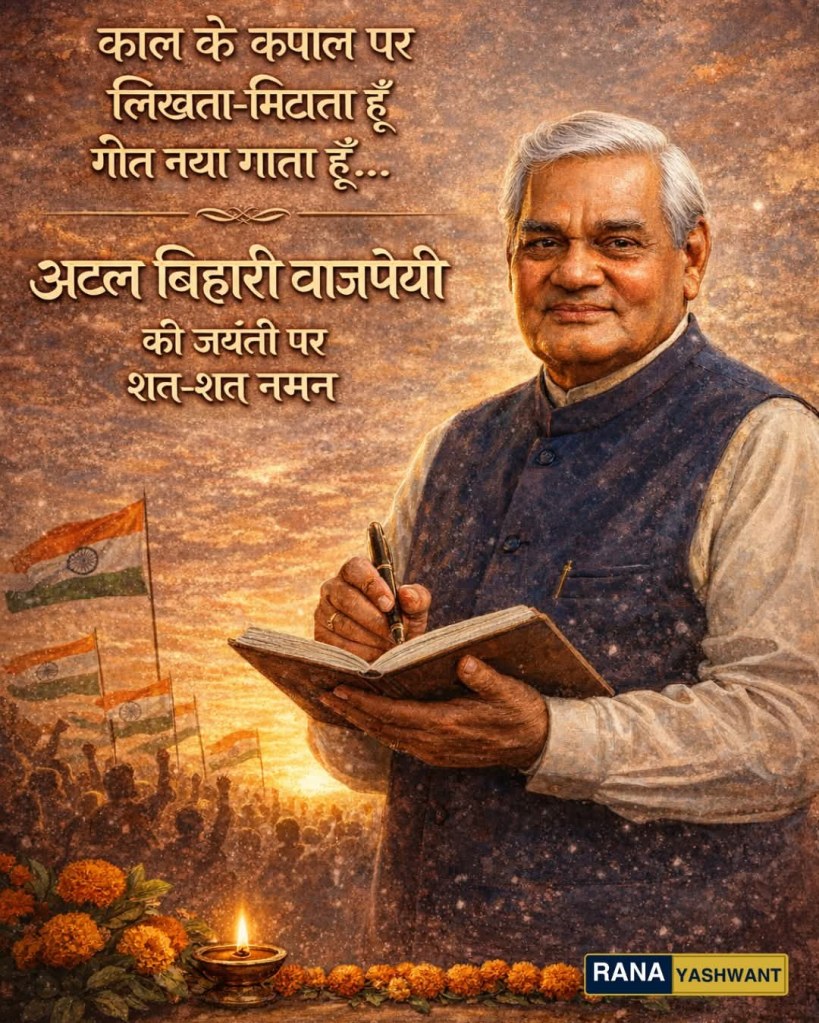
Special Correspondent: Arun Sharma
Early Life and Education
Bharat Ratna Atal Bihari Vajpayee was born on December 25, 1924, in Gwalior, Madhya Pradesh. His father, Krishna Bihari Vajpayee, was a school teacher and a poet, while his mother Krishna Devi was deeply religious and rooted in Indian values. This cultured and disciplined family environment laid the foundation for Atal ji’s nationalism, literary inclination, and moral strength.
He completed his early education in Gwalior and graduated from Victoria College (now Laxmibai College). He later earned a Master’s degree in Political Science from DAV College, Kanpur. Even as a student, Vajpayee was known for his powerful oratory and sharp intellect
Association with the Rashtriya Swayamsevak Sangh
Vajpayee’s public life began with his association with the Rashtriya Swayamsevak Sangh (RSS) during his teenage years. As a swayamsevak, he imbibed discipline, nationalism, and organizational skills. The RSS played a crucial role in shaping his character and preparing him for a life of public service.
Journalism and Literary Pursuits
Before entering active politics, Atal Bihari Vajpayee made a significant mark in journalism. He worked with publications such as Panchjanya, Veer Arjun, Swadesh, and Rashtradharma. His writings reflected deep nationalistic thought, social awareness, and human sensitivity.
Parallel to journalism, his poetic persona flourished. Vajpayee’s poetry was not merely literary expression but a philosophical reflection on life, democracy, love, pain, and patriotism. His verses resonated with both emotion and intellect.
Entry into Politics and the Jana Sangh Era
In 1951, under the leadership of Dr. Syama Prasad Mookerjee, Vajpayee formally entered politics through the Bharatiya Jana Sangh. After Dr. Mookerjee’s untimely demise, Vajpayee emerged as one of the party’s most influential leaders.
In 1957, he was elected to the Lok Sabha from Balrampur (Uttar Pradesh). His maiden speech in Parliament left a lasting impression, even on then Prime Minister Jawaharlal Nehru, who famously remarked:
“This young man will one day become the Prime Minister of India.”
A Graceful and Respected Leader of the Opposition
Vajpayee carved a unique identity as an opposition leader who criticized without bitterness and debated with dignity. His politics was rooted in dialogue rather than confrontation, earning him respect across party lines. He remained a rare figure admired both by the treasury benches and the opposition.
Foreign Minister and Global Recognition
In 1977, during the Janata Party government, Vajpayee served as India’s External Affairs Minister. His historic address in Hindi at the United Nations General Assembly marked a proud moment for India, asserting the nation’s cultural and linguistic identity on the global stage.
Formation of BJP and National Leadership
In 1980, the Bharatiya Janata Party (BJP) was formed, and Atal Bihari Vajpayee became its first national president. Under his leadership, the party evolved from an ideological organization into a mass-based national political force.
Journey to the Prime Minister’s Office
Atal Bihari Vajpayee served as Prime Minister of India three times:
1996 – For 13 days
1998–1999 – For 13 months
1999–2004 – Full five-year term
Key Achievements During His Tenure
Pokhran Nuclear Tests (1998)
Lahore Bus Yatra and peace initiatives with Pakistan
Golden Quadrilateral Highway Project
Acceleration of economic reforms
Expansion of IT and infrastructure sectors
The Poet-Prime Minister
Vajpayee’s poetic soul remained alive even at the height of power. His famous poems include:
“Main Nahin Mitoonga, Main Nahin Jhukoonga”
“Geet Nahin Gaata Hoon”
“Kadam Milakar Chalna Hoga”
“Aao Phir Se Diya Jalayen”
“Amar Aag Hai, Agnipath”
His poetry continues to inspire courage, hope, and national pride.
Demise and Enduring Legacy
Atal Bihari Vajpayee passed away on August 16, 2018, leaving behind a void in Indian public life. The nation lost a leader who symbolized sensitivity in politics, consensus in governance, and civility in disagreement.
Even today, he is remembered not merely as a politician, but as a statesman, poet, and visionary whose life bridged literature and leadership
Conclusion
Atal Bihari Vajpayee’s life stands as proof that politics can be humane, power can coexist with humility, and governance can be guided by a poet’s heart. He will forever shine as a guiding star in the firmament of India’s political and literary heritage.
 Modern Shrines Publications