

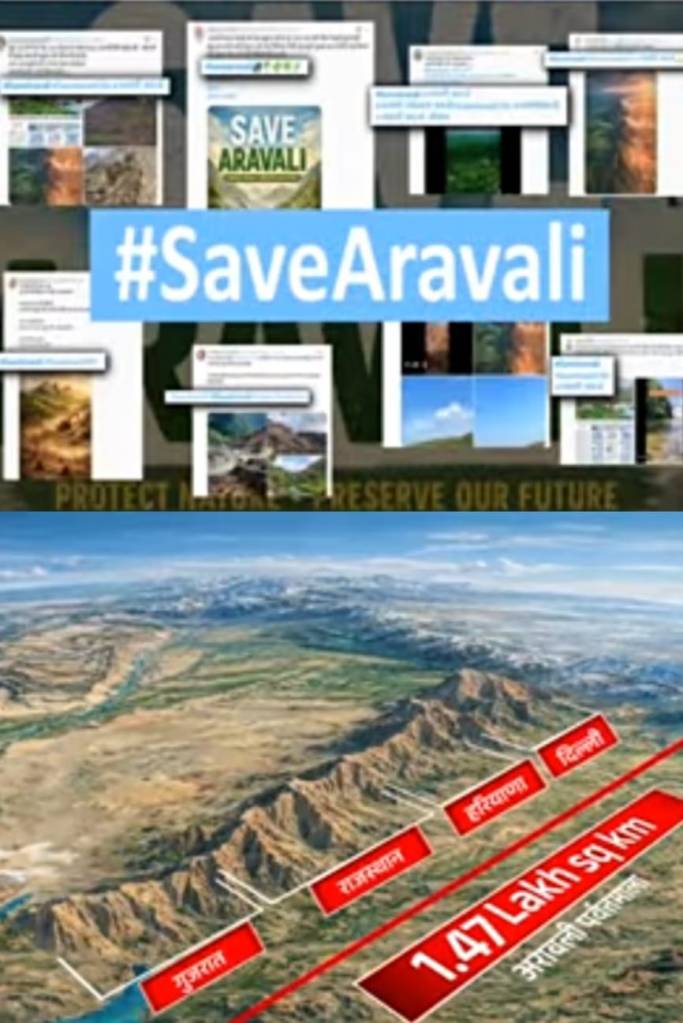
The Aravalli mountain range is the environmental backbone of the Indian subcontinent,the foundation of climate balance, and a natural barrier preventing desertification.

It would be wrong to limit the Aravalli mountain range controversy to a simple debate of mining versus the environment. The discussion on this issue should be based on facts, science, and law, not just social media slogans-Advocate Kishan Sanmukhdas Bhawnani, Gondia, Maharashtra
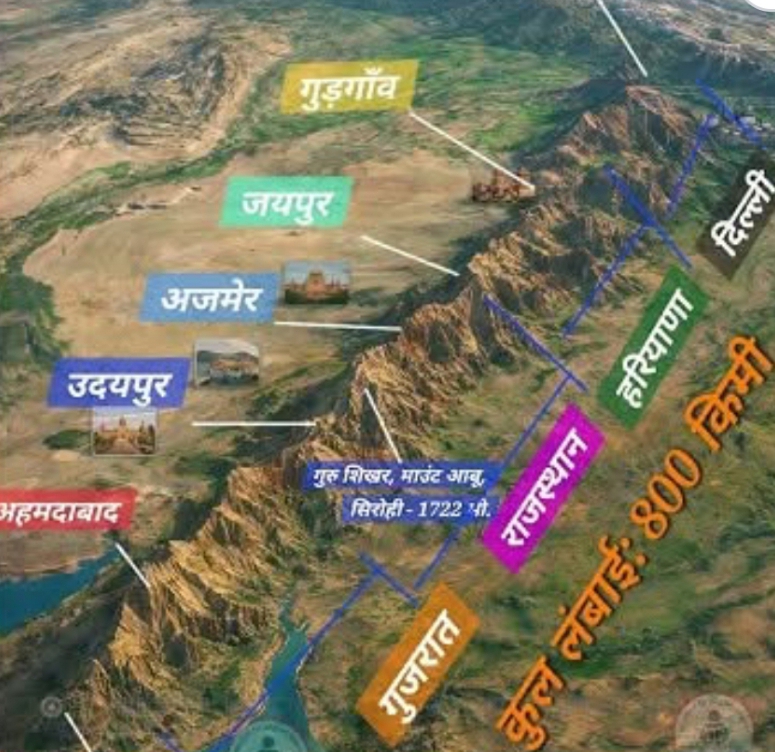
Gondia – Globally, the Aravalli mountain range is not just a geographical feature of India, but the environmental backbone of the Indian subcontinent, the foundation of climate balance, and a natural barrier preventing desertification.This mountain range, approximately 2 billion years old, is far older than human civilization. However, ironically, due to modern development, mining, urbanization,and policy ambiguities this very mountain range is now facing an existential crisis. Recently, hashtags like #SaveAravalli have been trending on social media regarding new mining regulations and Supreme Court orders. Allegations are being made that these regulations will weaken the Aravalli range instead of protecting it.I,Advocate KishanSanmukhdas Bhawnani, Gondia, Maharashtra, believe that in this context, it becomes necessary to conduct a comprehensive analysis of the entire controversy from a factual, legal, scientific, and international perspective, including the exchange of ideas and debates taking place on social and print media, based on the information available in the media.Let’s talk about understanding the Aravalli mountain range,itsgeographical extent, and historical significance.The Aravalli mountain range extends across the western part of India, covering Gujarat, Rajasthan, Haryana, and Delhi, with a total area of approximately 147,000 square kilometers. This mountain range starts from Palanpur in Gujarat and extends to Delhi. The highest peak of the Aravalli range is Guru Shikhar (1722 meters), located in Mount Abu.
Friends, This mountain range prevents theThar Desert from spreading eastward and plays a crucial role in maintaining the groundwater levels, monsoon patterns, and biodiversity of North India.Historically, the Aravalli range has served as a source of water, minerals, and natural protection during the Harappan civilization, the Rajput kingdoms, and the Mughal period. According to international geological standards, very few mountain ranges of such antiquity remain on Earth, making the preservation of the Aravalli range not only an Indian but also a global environmental responsibility. The allure of mineral wealth and mining:The Aravalli range is rich in mineral resources. Valuable minerals such as copper, zinc, lead, granite, marble, and copper are found here. The growing demand from industrial development and the construction sector has made the Aravalli range extremely attractive to the mining industry. Uncontrolled and illegal mining has taken place for decades, particularly in Rajasthan and Haryana, leading to the erosion of the mountains, destruction of forests, and drying up of water sources. This is where the conflict between development and conservation arises. This same debate has been observed internationally in the Amazon, the Andes, and the African Rift Valley.
Friends, Now, let’s consider the issue of four states, four different sets of rules, confusion, and a crisis of transparency. Because the Aravalli range spans four states, each state had its own mining and environmental regulations. In some places, the definition of hills differed, in others, there were no height limits, and in still others, the identification of forest areas was unclear. This inconsistency not only created administrative confusion but also allowed the mining mafia to exploit this ambiguity. According to the principles of international environmental governance, uniform rules are necessary for shared natural resources. A demand for a uniform policy for the Aravalli range has long been raised based on this principle.
Friends, if we talk about understanding the Supreme Court’s intervention and the decisive role of the judiciary, the Indian Supreme Court’s role in environmental protection cases is globally acclaimed. The Court’s interventions in the protection of the Ganges, Yamuna, the Taj Trapezium, and forests have been exemplary. In the Aravalli case, the Supreme Court, understanding the gravity of the situation, constituted a high-level committee. This committee included officials from the Ministry of Environment, the Forest Survey of India, the forest departments of the four states, and representatives from the Supreme Court itself. This structure was in line with international environmental commissions, where policy, science, and justice are coordinated.Committee’s Recommendations and Approval in November 2025The committee submitted its recommendations to the Supreme Court based on detailed surveys, satellite imagery, geological data,and environmental impact assessments.In November 2025, the Court approved these recommendations. These are the recommendations that are at the center of the controversy today. The first recommendation, the definition of 100-meter height – according to the new system, only hills 100 meters or higher will be considered part of the Aravalli range. Mining will be completely prohibited in such areas. Critics say that this will open up hills less than 100 meters high to mining. However, the committee argues that scientifically, a mountain range is identified by its height, continuity, and geological structure. This is also the distinction made between mountains and hills in international geological standards. The second recommendation, the principle of 500-meter continuity – the second important rule is that if the distance between two hills higher than 100 meters is less than 500 meters, then the entire area will be considered part of the Aravalli mountain range and there will be no mining. This rule is to protect the geographical continuity of the mountain range so that the mountains do not break into fragments due to mining. This principle is also adopted in the European Alps and the American Appalachian mountain ranges. Government’s stance – 90 percent of the area protected: According to government figures, the implementation of these rules will protect about 90 percent of the Aravalli region. Mining will only be possible in 0.19 percent of the area, or approximately 278 square kilometers. The government claims that this will stop illegal mining, bring clarity to regulations, and improve environmental monitoring.
Friends, if we talk about and try to understand the social media versus facts – #SaveAravalli controversy, we see that the campaigns running on social media have more emotional appeals and fewer facts. Many posts claimed that the Aravalli range is being legally destroyed, while the reality is that the Supreme Court’s orders provide legal strength to its protection. This trend is also seen globally, where complex environmental policies are presented in simplistic slogans, spreading confusion.
Friends, if we talk about international comparisons and where India’s policy stands, if we compare it with countries like Australia, Canada, and Chile, mining is permitted only in limited, controlled, and scientifically defined areas. The new rules created for the Aravalli range in India are in line with this global standard. The real challenge is not the rules, but their implementation. The root of the Aravalli crisis lies not only in the rules but in their honest implementation. If the local administration, environmental clearance process, and monitoring mechanisms are not strengthened, even the best rules can become ineffective.
Therefore, if we study and analyze the entire description above, we will find that conservation versus confusion, limiting the Aravalli mountain range controversy to a simple debate of mining versus environment would be wrong. The new Supreme Court rules, if viewed in the correct context, provide a solid legal framework for saving the Aravalli range. What is needed is a dialogue on this issue based on facts, science, and law, and not just on social media slogans. The conservation of the Aravalli range is not just a question for today’s generation, but a question of India’s water, climate, and life security for centuries to come.
Compiled by Author – Tax Expert, Columnist, Litterateur, International Writer, Thinker, Poet, sangeet madhyama, CA (ATC) Advocate Kishan Sanmukhdas Bhawnani, Gondia, Maharashtra 9284141425
 Modern Shrines Publications